Thursday, 12 March 2020

Royal Tunbridge Wells Property Values rise by 402% since 2000

As soon as people find out I am an agent in the property game, I nearly always get asked “Tell me what is happening to the Royal Tunbridge Wells Property Market”, and the answer isn’t always the same or indeed what they want to hear.

To start with, it really does depend on whether you are a buyer or seller. The property market in Royal Tunbridge Wells (like in all parts of the UK) swings like a pendulum between being a seller’s market or a buyer’s market yet, unless you are a Royal Tunbridge Wells first time buyer, Royal Tunbridge Wells buy to let landlord or executors selling a deceased persons estate, the vast majority of the time, people are both (i.e. they are selling to buy on).

The balance of power/negotiating power ultimately depends on simple supply and demand economics. Low supply (i.e. number of properties on the market) and high demand (i.e. large number of buyers) for any product or service (including your Royal Tunbridge Wells property) means prices tend to go up and high supply and low demand would mean prices tend to go down.

Yet supply and demand isn’t the only issue. Location is as important as the type of property and where it sits on the property ladder (i.e. is it at the lower, middle or upper end of the property market when it comes to size, type, price etc.).

Interestingly, the Government have released lots of data about the Royal Tunbridge Wells property market and, after many hours of number crunching, I have found some interesting trends. Whilst most stats look at the overall average of property values/prices, The Office of National Statistics (ONS), also likes to look at the bottom 10% of the market and the bottom 25% of the market.

It’s called the property ladder for a good reason, and the health of the whole Royal Tunbridge Wells property market is very dependent on those bottom rungs of the ladder.

Therefore, three sets of data are segmented as follows, based on the statistics given by the ONS ..

1.     Lower 10th Percentile of the Royal Tunbridge Wells housing market – i.e. the bottom 10% in terms of value of properties sold – e.g. small apartments and ex-local authority properties in the less popular areas which mainly attract buy to let landlords.
2.     Lower Quartile of the Royal Tunbridge Wells housing market – i.e. lowest 25% of Royal Tunbridge Wells property in terms of value of properties sold e.g. starter homes, first time buyer homes and slightly more up market buy to let property.
3.     Overall Average of the Royal Tunbridge Wells housing market – which takes into account the whole market from the top to the bottom.

…. And if one looks at our figures for Royal Tunbridge Wells and the local authority as a whole, you can see the three different parts have performed quite differently.


The ‘Lower 10th Percentile’ and ‘Lower Quartile’ parts of the Royal Tunbridge Wells property market have been driven over the last 20 years by two sets of buyers. The first are landlord investors who fuelled the increase of private rented properties in Royal Tunbridge Wells. 

The other set of buyers in the ‘Lower 10th Percentile’ and ‘Lower Quartile’ Royal Tunbridge Wells property market are the first-time buyers (FTB), which over the last couple of years, has been in the ascendency. 

Looking at the stats themselves …


Lower 10th
Royal Tunbridge Wells percentile

(i.e. the bottom 10% of the property market)
Lower
Royal Tunbridge Wells Quartile

(i.e. the bottom 25% of the property market)
Overall Royal Tunbridge Wells Average
2000
£56,900
£74,900
£91,800
2019
£210,000
£280,000
£460,800

You might ask, what do all these different figures mean to Royal Tunbridge Wells’ homeowners and Royal Tunbridge Wells’ landlords alike? Quite a lot – so let me explain. 

If we applied the best percentage uplift figure (i.e. from the Royal Tunbridge Wells ‘Average’ market), to that Royal Tunbridge Wells ‘Lower 10th percentile’ housing market 2000 figure, the 2019 figure in the table above of £210,000, would have been £285,600 instead – quite a difference you must agree?

Every Royal Tunbridge Wells’ homeowner and Royal Tunbridge Wells’ buy to let landlord should learn from this information that there are many mini-property markets and not just look at the overall averages. When you comprehend there isn’t just one Royal Tunbridge Wells Property Market, but many Royal Tunbridge Wells “mini-property markets”, you can spot trends and bag yourself some potential bargains. 


There are so many bargains in the Royal Tunbridge Wells property market at the moment, especially for Royal Tunbridge Wells buy to let landlords looking to expand their property empire. Do feel free to give me a call or drop me a line if you would like to know where they are!  

Friday, 21 February 2020

Royal Tunbridge Wells Property Market – Is it Time to ‘Plan’ to Get the Builders In?


 Even though the new legislation was placed on hold because of the recent General Election, it is expected the Government will start fining around half of all UK local authorities for failing to build enough new homes as Westminster starts to force local authorities to build more homes with the new laws.

The Conservative Government has gone on record with an ambition to build 300,000 new homes each year from the mid-2020s (aspiring as the average for the last 13 years has only been 177,000 pa). So Downing Street see the planning system as requiring root and branch change to ensure local authorities deliver on that promise.  The Ministry of Housing, Communities and Local Government’s ‘Housing Delivery Test’, which should be launched on an undetermined date this year, will hold local authorities to account for ensuring they hit their own specific house building targets. 

If a local authority is unable to show that it has a five-year stock of land for building new homes, it gives builders greater rights and liberties to build their new homes where the builder wants (not where the local authority wants). 

This will mean there will be a house building free-for-all

as the council will have less control over the setting, types of properties, contribution to infrastructure and location of any new home development. 

Only 44% of local authorities have a local plan that is less than five years old.

Locally, Tunbridge Wells isn’t in that 44% of local authorities. The current situation is, a draft Local Plan is in preparation.

Yet, the original question of this article was to find out if we are building enough homes in Royal Tunbridge Wells and the surrounding local authority area i.e. should we get the builders in? Well, the Government set targets for local authorities for the number of homes they should build each year. The latest set of data is for 2018, so for the three years up to and including 2018 i.e. 2016/2017/2018,

New home building target for Tunbridge Wells was 1,656 new homes, yet it achieved 1,457, a shortfall of 199 new homes


So, what does that all mean for the Royal Tunbridge Wells property market?

Even with the shortfall, there are positive and negatives to this. The Royal Tunbridge Wells property market is not broken, yet it does need to get the builders in. Irrespective of the results from the last three years, we have over three decades of under building, which has created issues regarding affordability of homeownership and older generations being stuck in homes too big because there aren’t enough suitable homes for them to move to, i.e. bungalows. The stabilisation of the General Election has been a net positive to overall confidence in the local property market, meaning Royal Tunbridge Wells homeowners and Royal Tunbridge Wells landlords looking to sell their home in the coming spring and summer will find decent demand (although sellers still need to realistic with their pricing).

Unfortunately, the negatives are that many Royal Tunbridge Wells renters that want to buy, are unable to as they can’t save after paying their rents and feel as if they’ve been left behind. I know the Government recently launched their “First Homes” scheme for selected first time buyers at the start of February, where a 30% discount would apply to “a proportion of new homes” and would be subsidised out of contributions from builders, the Tory’s have previously promised to build 200,000 cut price homes for first time buyers back in 2015, yet the National Audit Office has recently confirmed they never built a single one!

The simple fact is, we as a country need to build far more affordable homes in the areas where people want them. This means the dream of homeownership will be a greater possibility for our children and grandchildren in the future. Our local authority needs to continue to plan the housing needs (and associated infrastructure) to ensure that as we live longer and continue to grow as country - we have the homes in place to live in that are suitable for every generation.

Friday, 17 January 2020

Royal Tunbridge Wells’ Landlord’s £7.8m Tax Bill

I am asking Greg Clark the Conservative MP for  Tunbridge Wells to remind the Chancellor Sajid Javid and Prime Minster Boris Johnson to use their persuasive skills to highlight and take a more holistic approach and attitude to the private rented sector and tackle issues which affect a Royal Tunbridge Wells landlords’ capability and capacity to strategically run an effective buy-to-let business.

For the last thirty years, the Government have passed responsibility of housing the masses from local authorities (i.e. council housing) to the estimated 1.5 million British buy-to-let landlords.

However, since 2015/16, Royal Tunbridge Wells landlords have faced increasing tax burdens as each year goes by, with the removal of mortgage interest rate relief on income tax (Section 24), the introduction of the 3 percent surcharge on stamp duty, and the reduction of the letting relief on capital gains tax. 

My research has calculated the total income tax contribution by 2,059 Royal Tunbridge Wells private landlords in the tax year 2015/16 was £5,373,588

However, the eradication of higher rate mortgage interest relief (also known as Section 24) announced in 2015 by George Osborne has been estimated to add a further £1.9 billion nationally to landlord’s tax liability. Whilst raising money from landlords is an easy target, and the tax receipts attractive, it does make the landlords financial burden even heavier.

And by 2021/2, when the full extent of the Section 24 relief kicks in, that income tax liability will rise to £7,845,439
for those Royal Tunbridge Wells landlords

This doesn’t even take into account additional liabilities such as Capital Gains Tax, the 3% additional duty on top of the prevailing Stamp Duty Land Tax and VAT.

Ambiguity and a lack of certainty is the foe of all investment, which has been seen with Brexit. Now, just as things are starting to get rosy in Q1 with the pent-up demand released with the ‘Boris Bounce’, the last thing we need as a ‘collective’ property industry is for the Government to see us landlords as a constant cash cow. This new Tory government must acknowledge the value the majority of private landlords offer by housing in excess of 9.45 million people in the country. 

Westminster needs to take a balanced approach to the significant issues of possession (especially with the impeding removal of section 21 evictions), taxation and all rental properties needing to be at least an ‘E’ energy efficiency rating, to connect the value the private rented sector offers the country by effectively housing over a fifth of the population and avoid unintentional consequences by making renting a private rented property harder for tenants … because, it’s not financially viable to buy (or retain) a buy-to-let property with the way things are going against the landlord.

Sunday, 3 November 2019

The leasehold and ground rents scandal of Royal Tunbridge Wells

Freehold or Leasehold .. which is best? Well, when buying a property in the UK there are two main types of ownership – freehold and leasehold and, when boiled down, they mean the following...

Freehold: The person who owns the freehold of a property owns the property and the land it stands on.

Leasehold: As a leaseholder you do not own the land the property is built on. A leaseholder essentially rents the property from the freeholder for a number of years, decades or in some Victorian terraced houses, for centuries. 

All apartments have to be sold as leasehold properties because of the very nature that you have a neighbour above or below you (so both of you can’t own the land) with the length of the lease being over 100 years (even more sometimes). 

However, with some apartments – particularly Victorian and Edwardian houses converted into numerous apartments – which are sold on the basis that the leasehold apartment owner also owns part of the freehold (with other leaseholders in the same building), having what is known as 'share of freehold'.  Similarly, the Government also brought in legislation a number of years ago for more modern apartment blocks built in the 20th century where it allowed leaseholders to club together and have the right to purchase the freehold together.
Now we must stress, there is nothing wrong with leasehold – it’s been a useful type of homeownership since Norman times, it’s just that with a leasehold comes a potential extra responsibility. If there are four apartments in a block, who pays for the leaking roof when all benefit from a watertight roof? Who pays for the bad foundations, when all benefit from good foundations? Who pays for building insurances? .. the list goes on – so clauses are added to the leasehold agreement to ensure everyone is protected and pays their fair share of the joint costs of the building with service charges and a nominal ground rent (ground rent isa nominal rent, commonly quite low, often in the region of £50 per year to the freeholder of the property).

Whilst houses tend to be sold as freehold as it's a more unambiguous set-up, given there is only one property on the land. Contentiously however, in the last 20 to 25 years this has not always been the case with new-builds as some new homes’ builders have sold the leasehold to the buyer and retained the freehold. There is nothing wrong with that, it’s just in some cases (not all) they also added some oppressiveclauses to the lease of the property they were selling, which could be the next PPI scandal - albeit for property.

Government reports have emerged recently that suggest 12,000 leaseholders in the UK are facing ground rents – which they pay to the freeholder – that double in cost, usually every 10 years, but occasionally more frequently. 

Builders started to add clauses into leasehold property sales with ground rent being set at £300 and £400 a year, yet it doubled every ten years. Though unwary first-time buyers were habitually told that their 500 and 999-year leases were practically freehold, the clauses inescapably meant that the ground rent would spiral to ridiculous levels meaning the average ground rent would be £23,750 a year by 2070 and £379,900 a year by 2130, making the properties practically unsellable today, with owners often left unable to re-mortgage too.

So, how many people are affected by this in our local area?

Well, using Government data, our research suggests that in Royal Tunbridge Wells 49 householders have bought a detached house, semi-detached house or town house (which would normally be freehold) as  leasehold. Not all these have onerous lease clauses, yet some do. I know it doesn’t sound a lot, yet that is potentially 49 lives ruined with houses they can’t sell - making them prisoners in their own property.


The good news is the Government is on the case and serious about sorting this issue out as theyhave proposed a ban on the future sale of houses as leasehold, as well as cutting ground rents to zero. Yet stern questions remain about the future of homeowners in existing leaseholds. Westminster wants the builders to set up compensation plans, and we will say many (not all) have stepped up to the mark and started to sort this, although some campaigners have said the schemes are not fit for purpose, let’s hope they are wrong.

Wednesday, 23 October 2019

How long is an average Royal Tunbridge Wells property on the market for?

If you are either selling or buying a property in Royal Tunbridge Wells, there are a few reasons why it may be taking some time to sell your Royal Tunbridge Wells home or find that perfect place to call your new home. It may be taking longer than you thought to find a buyer for your home because of the current state of the property market or finding that perfect Royal Tunbridge Wells home may be taking too long because of a lack of properties to buy.

So, taking everything into consideration, all of these factorsinvite an obvious question; how long is too long to persist in the Royal Tunbridge Wells property market?

If you are looking to sell your Royal Tunbridge Wells property, it may have become infuriating when your home has been on the market for longer than you anticipated. Perhaps the property market is purely in a position where it's challenging to get a property sold quickly, or sold at the price you want to achieve for it. If you do live in a Royal Tunbridge Wells home that is towards the upper reaches of the price band, you have to be open to the idea that because it's worth so much more than the average property in Royal Tunbridge Wells and so more than most individuals can afford, you will have to wait longer to get it sold.

Your Royal Tunbridge Wells home might be taking longer to sell because your asking price is simply too high. Even if you are prepared to take a realistic offer, if you have an unrealistic asking price your overpriced Royal Tunbridge Wells property will undoubtedly turn off potential buyers from even being inclined to book a viewing.

Looking at the market in Royal Tunbridge Wells compared to a year ago makes very interesting reading…


When it comes to the average length of time on the market, it’s the terraced homes and apartments in Royal Tunbridge Wells that appear to be taking longer to sell, yet the length of time Royal Tunbridge Wells detached and semi-detached homes seem to be on the market has dropped.

The overall average length of time a Royal Tunbridge Wells property remains on the market has risen by 7.2%, from 76 days a year to 82 days today

The question that remains is, if you are having no luck selling should you leave your Royal Tunbridge Wells property on the market or not? This is basically down to your personal circumstances - a big decider has to be if you are moving up market or downsizing. 

Buyers will compare your Royal Tunbridge Wells property to all the other homes on the market using the portals such as Rightmove, On the Market and Zoopla and even if your asking price is realistic, if your marketing (brochures, pictures, even video walk through) isn’t top dollar, they will dismiss your property. 

Remember, the average buyer only views 4.5 properties before they buy and on average, each buyer will only spend just over 25 minutes viewing each home  …

The more properties that are on the market, the greater the choice for buyers (yet more competition for house sellers), so we wanted to look at how many homes were for sale in Royal Tunbridge Wells now, compared to 12 months ago.

As you can see, there are some differences between the property types in Royal Tunbridge Wells.


As for buying a Royal Tunbridge Wells property, searching for that dream house can take time as you have to consider the needs of your spouse, children, schooling, etc., what you can realistically afford and whether your current location can accommodate you until you find that perfect Royal Tunbridge Wells home.

Don’t forget that upwards of 10% of homes do not make it to the portals (the portals are Rightmove, Zoopla and On the Market), so don’t just rely on the portals to let you know what is coming on the market. The number of times I speak to disappointed buyers who missed out because other buyers registered directly with the agent for property, whilst they relied on the portals.


When it comes to buying a Royal Tunbridge Wells home, and so you do not make any decisions you will regret later on, taking your time is always the more practical option. The amount of money that is involved in buying a home and all the costs connected with it means that you should not rush into buying or selling without due consideration.

Friday, 4 October 2019

What’s the biggest street in Royal Tunbridge Wells (TN1)?

Most weeks, my articles on the Royal Tunbridge Wells property market tackle some of the big issues about the local property market, such as the lack of new homes being built in Royal Tunbridge Wells, the trials and tribulations of being a Royal Tunbridge Wells buy-to-let landlord and the future of the Royal Tunbridge Wells property market .. yet in this article, I wanted to give you some fun facts about the Royal Tunbridge Wells property market – which is the largest street in TN1 by the number of properties on it?

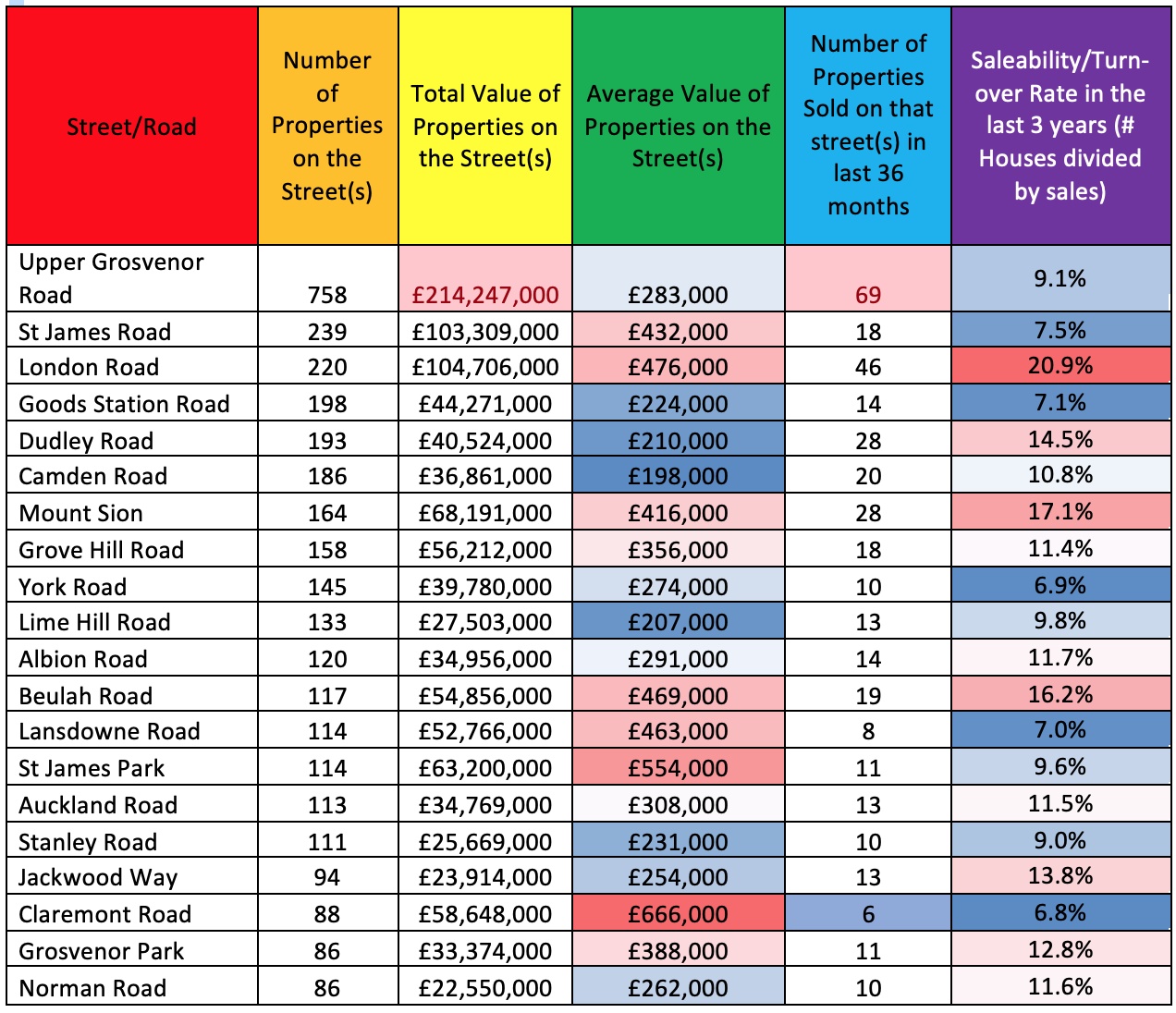
The biggest street in TN1, when it comes to the number of houses on it is Upper Grosvenor Road, with 758 homes. In second place is St James Road with 239 homes and in third is London Road with 220 homes.


Not surprisingly, the most valuable street of the top 20 biggest streets is Upper Grosvenor Road at £214.2m with an average value of £283,000 per property.

The street with the greatest number of movers in the last 3 years is also Upper Grosvenor Road, yet its saleability rate was only 9.1%, with London Road having the highest saleability rate of 20.9%.

The full breakdown can be found in this chart below.


Yet, did you really think I wouldn’t get at all serious .. 

The basic rudiments of the Royal Tunbridge Wells property market remain principally healthy in many parts of Royal Tunbridge Wells, yet the existing political environment means that the vital element of confidence has been diminished slightly in certain parts, and that is triggering a minority of potential property purchasers and house-sellers to vacillate, yet with unemployment at an all-time low, a record number of people with a job, ultra-low interest rates and decent mortgage availability (with the Banks and Building Societies tending to drop mortgage rates instead of increasing them), those Royal Tunbridge Wells first time buyers (and especially Royal Tunbridge Wells buy-to-let landlords) who have adjourned their next house purchase because of perceived political uncertainty should be reminded that talking to many of my fellow Royal Tunbridge Wells agents they have more homes on their books than at any time for the last three or four years, so there is a greater choice of Royal Tunbridge Wells properties to call your next home/BTL investment with a potential of securing a great property deal in the next month or so.

Irrespective of what happens with Brexit, Royal Tunbridge Wells people will still need a roof over their heads and as I have mentioned on a number of occasions, I have proved beyond doubt we aren’t building enough homes both locally in Royal Tunbridge Wells and nationally. If supply is limited and demand increases (as the population grows and we get older), prices in the medium to long term can only go in one direction. Upwards!

So, whatever happens with BoJo and Brexit – why wait, because once we get over that hurdle, there will just be another hurdle and another hurdle and by which time – we will be in 2029 and you would have missed the boat. We survived the Global Financial Crash, 3-day week in 1970s’, hyperinflation etc etc …  yet the choice is yours.


Wednesday, 18 September 2019

Royal Tunbridge Wells Property Market Update Summer 2019

The foundations of the Royal Tunbridge Wells Property Market over the summer have continued to be principally sound; yet the existing political macroclimate means that the critical element of consumer confidence has been reduced and that is triggering some potential Royal Tunbridge Wells property buyers and Royal Tunbridge Wells house sellers to falter slightly and hang fire making any firm decisions on property.

With record low interest rates at 0.75%, low unemployment rates of 3.8%, and decent mortgage availability (even those with low deposits - there were 224 mortgage deals available on the day of writing this article where only a 5% deposit was required and 5 main stream lenders that would offer 100% no deposit mortgages), Royal Tunbridge Wells buyers have a lot going in their favour, aside from the perceived political uncertainty. 

Interestingly, Rightmove have stated there are more properties for sale today in the Country, than at any time since 2016, and Royal Tunbridge Wells follows that trend. Even with that in mind, property values have remained reasonably stable as The Land Registry has just released its House Price Index for Royal Tunbridge Wells and the surrounding locality and it makes very interesting reading.

Overall, property values in the Royal Tunbridge Wells area are 3% lower than a year ago as the average property value in Royal Tunbridge Wells now stands at £493,900.

When I looked at the types of Royal Tunbridge Wells’ properties, a slightly different picture appeared ..

·     Royal Tunbridge Wells Detached homes dropped by 2.3%
·     Royal Tunbridge Wells Semi-detached homes dropped by 2.2% 
·     Royal Tunbridge Wells Terraced/Town-House dropped by 2.8%
·     Royal Tunbridge Wells Flats/Apartments dropped by 4.7%

and splitting down the types of Royal Tunbridge Wells into property types ..

·     Royal Tunbridge Wells Detached £846,100
·     Royal Tunbridge Wells Semi-Detached £459,700
·     Royal Tunbridge Wells Terraced/Town-House £388,700
·     Royal Tunbridge Wells Flats/Apartments £282,300


Yet, Royal Tunbridge Wells Property Market Blog readers will know I always like to measure the health of the Royal Tunbridge Wells property market not only by house prices but transaction levels as well ..

1,128 properties were sold in the last year in Royal Tunbridge Wells,
 lower than the 10-year average of 1,386 properties per annum

Considering the uncertainty the Country has been through in the last three years with the ‘B’ word issue, I don’t think that’s too bad and shows the underlying resilience of the Royal Tunbridge Wells property market.

Now looking forward towards the end of the year .. how will Royal Tunbridge Wells’ house values change under the new Prime Minister?

Royal Tunbridge Wells buy-to-let landlords and Royal Tunbridge Wells first-time buyers seem to be sustaining their preceding activity levels, which is heartening news. It’s quite conceivable that both cohorts are presently profiting from the marginally increased numbers of Royal Tunbridge Wells homes on the market, which not only offers them greater choice, but aids with their negotiations. The suggested Stamp Duty changes made me look at previous Stamp Duty changes in the last decade and their effects have been rather short term.

That means those selling their homes in Royal Tunbridge Wells need to be realistic with their pricing, and, as most sellers also buy a property, what you might lose on your sale you will make up on the purchase.  


BoJo, Brexit … to be honest are all short-term distractions from the long-term issues of the UK and Royal Tunbridge Wells property market. Until we start building at least 300,000 properties a year to meet the demand for UK property, demand will always outstrip supply, meaning irrespective of short-term fluctuations that may (or may not) be caused by domestic and world events (including the ‘B’ word’), prices will always in the medium to long term remain stable and increase.

Sunday, 1 September 2019

Royal Tunbridge Wells Homeowners can now build larger extensions without planning permission.

The need for more homes has always been one of the biggest issues with regard to the Country’s housing crisis.  One of the main reasons for families wanting to move home is the need for more accommodation as their families grow and so in 2013 and 2015, the planning permission rules were relaxed to try an alleviate this issue.

Initially in 2013, Nick Clegg, as Deputy Prime Mister, brought in temporary planning rules to allow larger single storey rear extensions without the requirement of a full planning application.  The temporary rules allowed terraced and semi-detached homes to be extended by just over 19ft, whilst detached houses were able to add even bigger extensions of up to 24ft.  Since those rules were relaxed six years ago, 109,320 people have taken advantage of the temporary rules (aka “permitted development size guidelines”).

Homeowners wanting to extend within these permitted development guidelines, must still inform the local authority of the extension beforehand, and local authority officials still need to then notify the neighbours.  If the neighbours object, the local authority could still stop the extension being built, but only if it is likely to damage the character or enjoyment of the neighbourhood.  The planning process exists for a reason and whilst these relaxed planning rules are popular with property owners, it does mean local authorities have little chance to deliberate the impact of these extensions on their locality.  However, 22,779 permitted developments had been refused in the same time frame meaning, 17.2% of permitted development planning applications have been refused since 2013.
Now these temporary rules have been made permanent recently as the Government believe these measures will help households extend their properties without fighting through the time-consuming red tape of obtaining planning permission.  The government believes this is part of a package of planning reforms to build more households, build them better, quicker and make the housing market work, meaning families can grow without being forced to sell and move… or does it?

The average size of a property 
in Royal Tunbridge Wells is 1,036 sq.ft

.. internally (1,187 sq.ft  externally), whilst to the national average 929 sq.ft internally (1,081 sq.ft externally).  Interesting when compared to the average size of a new homes built nationally which is 12.1% lower at 818 sq.ft internally (927 sq.ft externally).

These relaxed rules are only for single-storey extensions though, when most growing families don’t need an extra downstairs reception room, they need an additional upstairs bedroom.  This means if families do want an extra bedroom upstairs, they will still have to go through the rigmarole of submitting a full planning permission.  Although, many Royal Tunbridge Wells people have used these rules in the last 6 years to build a decent size granny-annex – there are other options less explored out there.

There was a second (less advertised) temporary change the Government made to planning rules in 2015, that has also been made permanent recently, many may have missed it, yet it has a bigger potential impact on the housing market.  The new rules make permanent the removal of planning rules to allow office blocks and shops to be converted into residential homes without a full planning application being made.  Since 2013, 11,090 office blocks and 1,750 shops have been converted into residential households.  This doesn’t sound a lot, but in 2017 alone, converted shops and office blocks provided 37,000 new households alone in the Country (or 17% of the new household created in 2017).

Over the next decade, more and more office blocks and shops will be converted into residential properties … and this will slowly change the dynamic of the housing market and the high street … and I’m not sure whether that will be for the good or bad ... only time will tell?